The Internet is most people's second, external brain that they depend upon for almost everything imaginable. The experts surveyed by Elon University's Imagining the Internet Center and the Pew Internet Project said "the effects of hyperconnectivity and the always-on lifestyles of young people will be most likely positive between now and 2020."(pewinternet.org)
Following are the major findings based on the survey of experts by the Pew Internet & American Life Project:
(pewresearch.org)
__________________________________________________________________________________________________________
As of right now, 1.5 billion people connect to the Internet every day, but in a few years, once the Internet has becom egenuinely mobile, over 4 billion users and billions more devices and objects will be connected anywhere and anytime (ec.europa.eu). However, before this can happen, europa.eu says that "The Internet must undergo important changes."
__________________________________________________________________________________________________________
Experts say the next generation of young people will beneift and suffer from their always-on lifestyles (elon.edu).
__________________________________________________________________________________________________________
"In a few years, we’ll look back in amazement that in 2011 we still used brokers to help us find houses, that doctors kept records scribbled on notepads, that government information was carefully spoon-fed to a compliant press corps, and that scarcity of information and tools was a primary inhibitor to education" (article.businessinsider.com)
__________________________________________________________________________________________________________
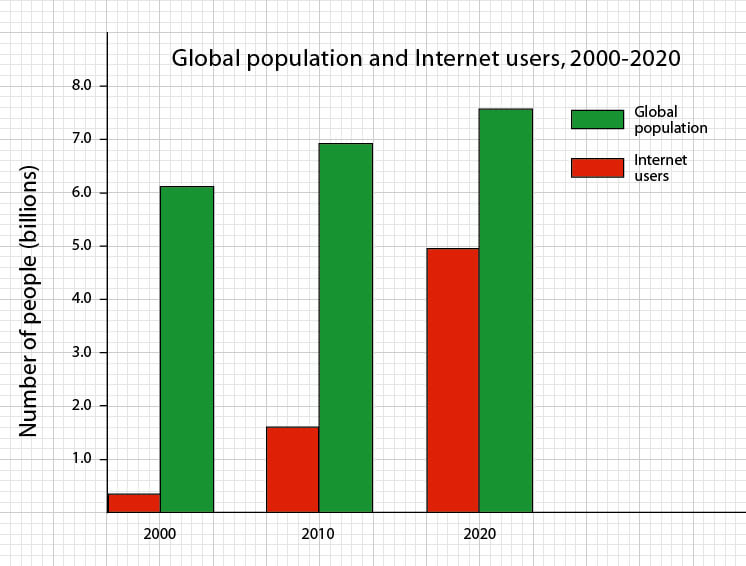
This graph is from www.futuretimeline.net
__________________________________________________________________________________________________________
It will become the medium by which we keep in constant contact with our families, watch television, dash off a note to a friend, check the traffic, read the newspaper, prepare a report for work, make a phone call, buy a book. The Internet is destined to become so ubiquitous that the novelty of its usage will fade into the background. It's going to be almost as common as breathing (Breathing is Aslo Addictive).
References:
Levy, Steven. "Breathing is also addictive." Newsweek 30 Dec. 1996: 52. Academic Search Premier. Web. 24 Apr. 2012.
Dixon, Chris. "Predicting the Future of the Internet is Easy." Business Insider Jan. 2011: 13. Google. Web. 15 Apr. 2012
Fox, Will. "Computers & the Internet." FutureTimeline 2012 Google. Web. 14 Apr. 2012
"The 2012 Survery." Imagining the Internet 2012 Google. Web. 16 Apr. 2012
Anderson, Jenna and Rainie, Lee. "Millennials will benefit and suffer due to their hyperconnected lives." Pew Internet Feb. 2012: 29. Google. Web. 14 Apr. 2012.
Anderson, Jenna and Rainie, Lee. "Future of the Internet III: How the Experts See It." Pew Research Center Publications Dec. 2008: 14. Google. Web. 16 Apr. 2012
"The Future of the Internet." Europe's Information Society Google Web. 15 Apr. 2012
